In the communities in East Africa and Southeast Asia where IIRR works, families continually struggle not only to provide food for their families, but also to access to local markets. In addition to hunger and malnutrition, incomplete education and weak value chains play a large part in the poverty faced by many rural communities. The poor, often illiterate rural farmers and small producers usually do not have the skills they need to make their businesses as efficient as possible. They may be sidelined or eliminated from the production and distribution process, they may not have access to capital, or they may lack information about pricing, planning, and market demand, making it difficult to demand a fair price for goods and services or make informed business decisions.
In order to reverse the trend of poverty and food insecurity, communities, farmers and small producers must be able to use effective agricultural techniques, understand nutritional needs, participate in value chains that link them to suppliers, traders, and consumers, and have access to savings, crop-storage, and other agricultural support mechanisms. Through local partnerships, IIRR is working to empower teachers, parents, farmers and micro-entrepreneurs through innovative agricultural training, farmer cooperative-support mechanisms, increased access to markets, and a focus on sharing of best practices related to bio-intensive gardening, livelihood training, value chains, and micro-enterprise.
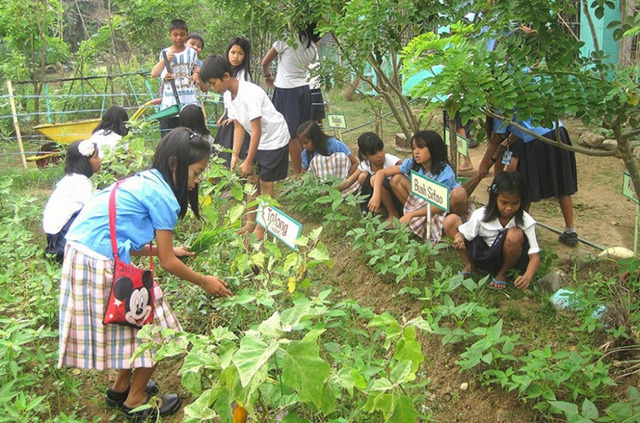
Bio-Intensive Gardening utilizes a small plot of land to grow locally-thriving plants using natural fertilizers and locally-tailored organic gardening methods. This method does not require chemical fertilizers, is environmentally friendly, sustainable, and easily altered to target what works in each country. Since 1980, IIRR has been implementing BIG programs, and in 2005 IIRR began implementing the BIG program directly in the classrooms of poor, rural schools in the Philippines. The BIG program simultaneously reduces malnutrition while also providing life-long agriculture skills to communities. Through this initiative, IIRR has been able to start school, home, and community gardens and to train children, parents, and community members in bio-intensive gardening.